
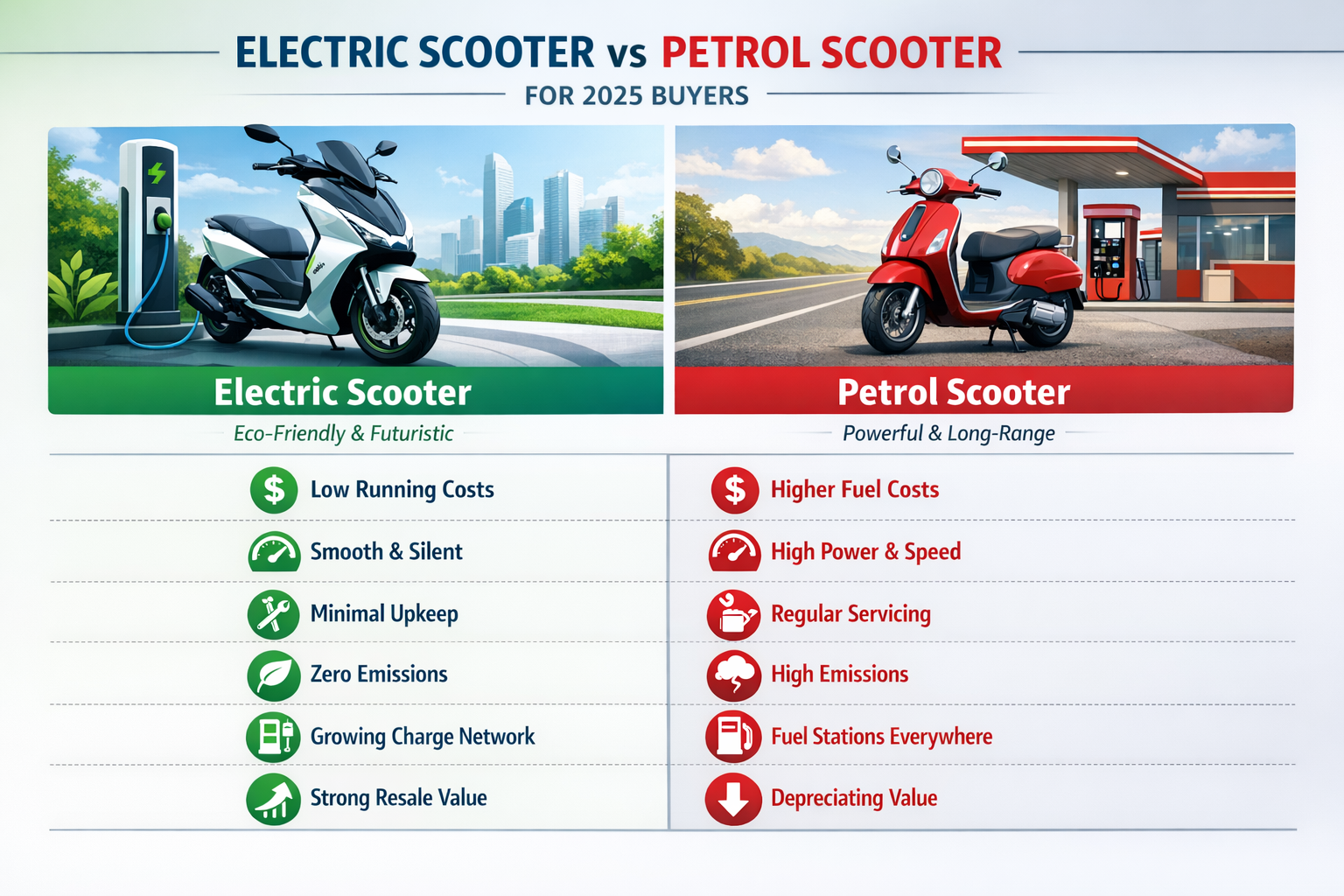
Choosing between an electric scooter and a petrol scooter is one of the biggest decisions for urban commuters and daily riders today. With rising fuel costs, environmental concerns, and rapid improvements in battery technology, electric scooters are gaining popularity. But petrol scooters still hold strong with familiar performance and wide service networks. In this comparison, we break down both options across key factors like cost, performance, maintenance, environment, convenience, and long-term value to help you decide what fits your lifestyle in 2025.
🔋 1. Cost of Ownership – Wallet Wise Comparison
Electric Scooter
One of the biggest advantages of electric scooters is the lower cost of ownership. Electricity is significantly cheaper than petrol on a per-kilometer basis. For example, a full charge can cost just a few rupees and deliver 60–100 km of range (depending on the model and riding conditions). Many electric scooters also qualify for government subsidies and tax breaks, further reducing upfront costs.
Insurance and registration costs for electric two-wheelers tend to be lower in many regions too.
Petrol Scooter
Petrol scooters typically have lower upfront prices compared to premium electric models, which can make them appealing for budget buyers. However, the running cost adds up quickly because petrol prices fluctuate and are generally high. Over time, fuel expenses, engine servicing, and periodic parts replacement can make petrol scooters more expensive in overall ownership cost.
Verdict: Electric scooters win on long-term ownership cost, while petrol scooters may win on lower initial purchase cost.
⚙️ 2. Performance & Riding Experience
Electric Scooter
Electric scooters offer instant torque, meaning acceleration from a stop feels smooth and peppy. Many riders enjoy the silent, vibration-free experience. They are ideal for urban commuting, short trips, and stop-and-go traffic. Modern electric scooters can reach respectable top speeds (50-90 km/h) depending on model and motor capacity.
However, range limitation is a factor — despite improvements, heavy traffic or frequent hills can reduce effective range. Charging time (usually several hours) is also something riders must plan around, especially without fast-charging options.
Petrol Scooter
Petrol scooters typically offer consistent performance across distances. They can handle longer rides and open roads well and refuel in minutes at any petrol station. The riding range is usually higher than many budget electric scooters, and power delivery can be stronger in higher-engine capacity models.
On the downside, petrol engines produce vibration, noise, and require regular oil changes and tune-ups.
Verdict:
- Electric for smooth city riding and short daily use.
- Petrol for longer distance comfort and quick refueling.
🔧 3. Maintenance & Reliability
Electric Scooter
Electric scooters have fewer moving parts — no engine oil, no spark plugs, no carburetor, and fewer vibration-inducing components. This generally leads to lower maintenance costs and fewer trips to the mechanic. Brake wear can also be reduced due to regenerative braking on many models.
Battery health, however, is an important long-term consideration. Most manufacturers provide battery warranties (2–3 years or 20,000+ km), but eventual battery replacement can be expensive.
Petrol Scooter
Petrol scooters have more mechanical complexity and require more frequent servicing — oil changes, belt/chain maintenance, spark plug replacement, and periodic tune-ups. Parts and servicing are widely available due to the long history and extensive dealership networks for petrol scooters.
Verdict: Electric scooters will likely cost less to maintain overall, but petrol scooters win for service accessibility in remote areas.
🌍 4. Environment & Sustainability
Electric Scooter
Electric scooters produce ZERO tailpipe emissions, which means cleaner air in cities and reduced greenhouse gas impact (especially if charged with renewable energy). They are a top choice for eco-conscious riders and fit well with smart city and sustainability goals.
Lifecycle environmental impact depends on how electricity is generated and how batteries are recycled — but on average, electric scooters have a smaller carbon footprint than petrol counterparts.
Petrol Scooter
Petrol scooters emit CO2 and pollutants, contributing to air pollution and environmental degradation. While modern engines are cleaner than older ones, they still rely on fossil fuels, which have ongoing environmental costs.
Verdict: Electric scooters are greener and more sustainable.
⛽ 5. Convenience & Infrastructure
Electric Scooter
Charging infrastructure is improving rapidly in many cities, with dedicated charging stations, portable chargers, and even home charging solutions. However, infrastructure still lags behind petrol pumps in many regions, which can be a drawback for riders without home charging access.
Petrol Scooter
The petrol infrastructure is almost universal — petrol pumps are everywhere, and refueling takes just minutes. This makes petrol scooters extremely convenient for intercity and rural travel.
Verdict: Petrol scooters currently lead in infrastructure convenience, but electric charging networks are catching up.
📈 6. Resale Value & Future Trends
Electric scooters are newer in the market, so resale values are still stabilizing. As battery tech improves and prices drop, early adopters may see strong resale value.
Petrol scooters have established resale markets and higher liquidity due to years of demand.
Future trends clearly favor electric mobility as governments push for EV adoption, emission regulations, and incentives.
Verdict: Electric scooters are a future-focused investment, while petrol scooters maintain stable traditional resale value for now.
🏁 Final Verdict — Electric vs Petrol Scooter
Both electric and petrol scooters have their strengths:
Choose an Electric Scooter if you want:
✔ Lowest running and maintenance costs
✔ Eco-friendly commuting
✔ Quiet, smooth city rides
✔ Future-ready transport
Choose a Petrol Scooter if you want:
✔ Lower initial purchase price
✔ Long range and quick refueling
✔ Easy service access
✔ Better rural and highway performance
In 2025, electric scooters are rapidly becoming the smarter urban choice, especially for daily commuters and environment-conscious riders. Petrol scooters still make sense where infrastructure or long-distance flexibility matters.